

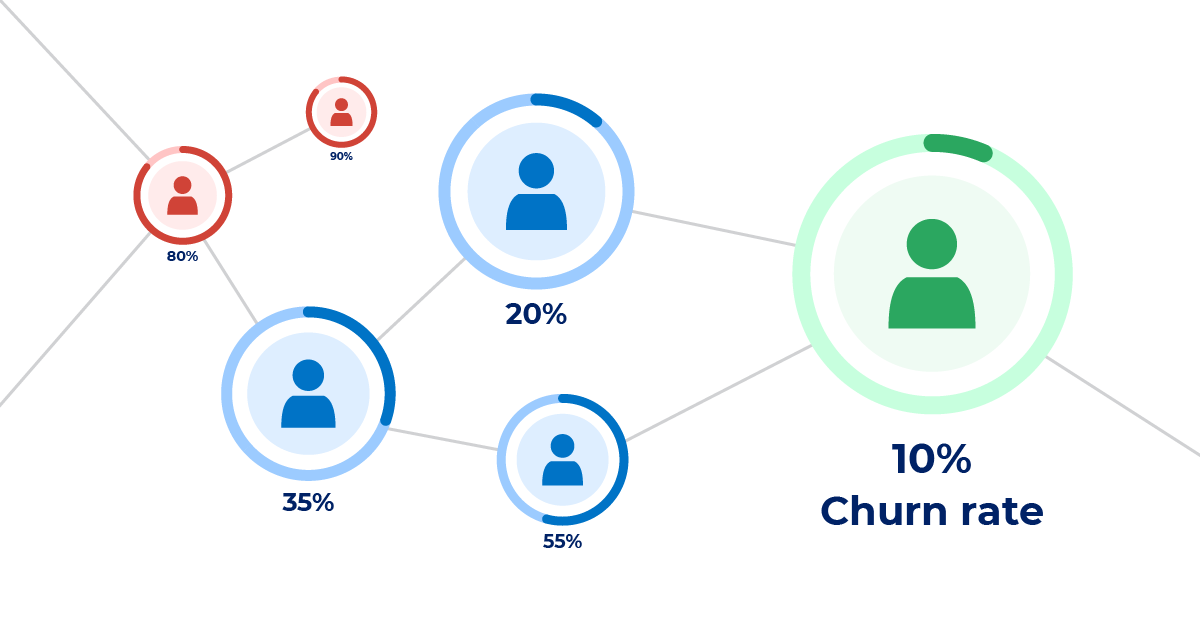
Think of a busy café on a Monday morning. Some customers order their favourite brew and return daily, while others vanish after a single visit, never to be seen again. The cafe owner, if observant, starts recognising patterns-who lingers, who looks dissatisfied, and who might never return. Data science is that observant café owner, only scaled up with algorithms, numbers, and machines to predict behaviours across millions of customers.
Customer churn-when clients discontinue services-remains one of the most pressing challenges across industries. Using machine learning, organisations can uncover subtle signals and predict churn before it happens, allowing proactive strategies to retain loyal customers.
Understanding the Signals Behind Churn
Customer churn rarely happens overnight. It is a gradual process, similar to a friend drifting away-not returning calls, cancelling plans, and showing less interest over time. Businesses face the same subtle cues: reduced logins, fewer purchases, or increased complaints.
Machine learning thrives on recognising such patterns. By studying customer activity logs, transaction histories, and engagement metrics, algorithms can identify early warning signs. For learners, building this level of intuition often begins with a Data Science Course, where the focus is on recognising signals that lie beneath surface-level behaviour.
Collecting and Preparing the Data
Imagine trying to forecast the weather with scattered, incomplete maps. Predicting churn without well-prepared data is equally futile. Data must be cleaned, standardised, and structured before machine learning models can make sense of it.
This stage involves gathering customer details, subscription lengths, frequency of complaints, and interaction histories. Missing values are addressed, categorical variables transformed into numerical form, and datasets balanced so that models don’t lean heavily toward non-churn cases.
In Bangalore, where tech companies face large-scale churn challenges in the SaaS and telecom sectors, mastering this process through a Data Science Course in Bangalore equips professionals to design real-world, business-ready datasets.
Building the Prediction Model
At the heart of churn prediction lies the model itself. Logistic regression, decision trees, random forests, and gradient boosting are common contenders. Each comes with its own storytelling power-some provide a simple yes/no narrative, while others explore complex, layered decision paths.
Modern organisations often blend multiple models into ensembles for better accuracy. The process is iterative: train, validate, and refine until predictions closely mirror real-world outcomes. The hands-on practice of building such models is often introduced in a Data Science Course, where learners move from theory into implementation, discovering how algorithms behave with real churn datasets.
Deploying Insights into Action
Predictions without action are like a fire alarm ignored in a building. Once churn risks are identified, companies must act decisively. This might mean offering personalised discounts, improving onboarding experiences, or sending timely reminders.
Machine learning doesn’t just stop at prediction-it powers customer success dashboards, real-time alerts, and automated interventions. Visualisations highlight at-risk customers, while integrations with CRM tools allow frontline teams to respond quickly.
Practical exposure to such deployment pipelines often takes shape in a Data Science Course in Bangalore, where learners simulate real scenarios of building, testing, and embedding churn models into business systems.
Challenges and Human Understanding
While machine learning sharpens foresight, human judgment remains vital. Some customers may churn due to unpredictable reasons-a change in personal circumstances or market disruptions-that no model can capture. Businesses must treat predictions as guiding compasses, not absolute truths.
An empathetic approach, where numbers are paired with human interaction, leads to better retention outcomes. For those who train through a structured Data Science Course, this balance between technical prediction and human context becomes an essential takeaway.
Conclusion
Predicting customer churn with machine learning is less about crunching data and more about storytelling-listening to the subtle cues of customer behaviour and translating them into proactive strategies. From preparing data to deploying real-time insights, the journey blends technology with intuition.
For professionals aspiring to master this craft, a Data Science Course in Bangalore provides the perfect environment to learn, experiment, and apply churn prediction models in practice. With the right tools and mindset, businesses can move from reactive firefighting to proactive customer success-turning potential losses into long-term loyalty.
For more details visit us:
Name: ExcelR – Data Science, Generative AI, Artificial Intelligence Course in Bangalore
Address: Unit No. T-2 4th Floor, Raja Ikon Sy, No.89/1 Munnekolala, Village, Marathahalli – Sarjapur Outer Ring Rd, above Yes Bank, Marathahalli, Bengaluru, Karnataka 560037
Phone: 087929 28623
Email: enquiry@excelr.com
